
Security does not
end at sign-in.

To be able to protect yourself, you need to know your own processes better than anybody else.

Built to help people challenge AI.
Not to replace their judgment.

Quiet architectural space with deep green glass arches
Security does not end at sign-in. Defense with work context.

An account can be valid.
An action can still need scrutiny.

We're building a defense layer that brings company rules, roles and approved work into the picture after access has been granted.

The aim: protect that boundary without treating every unfamiliar action as an attack.

What happens after access.

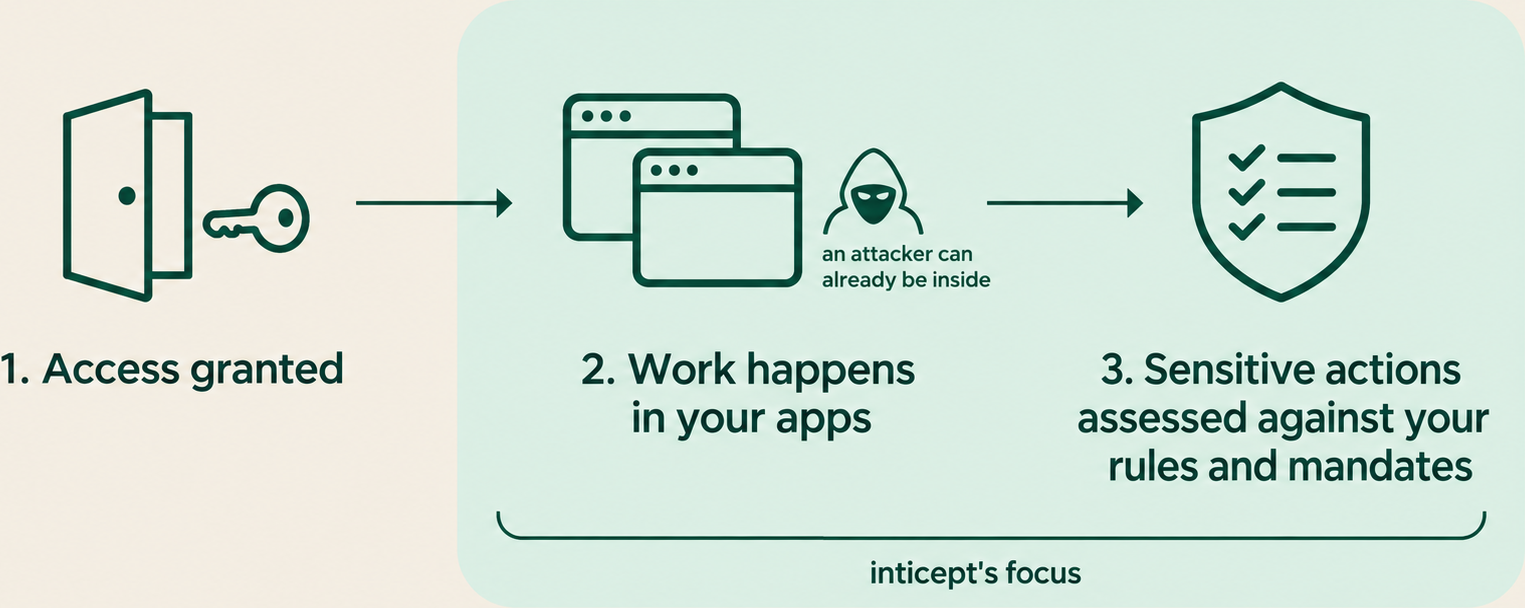
Flow: access is granted, work happens in your apps where an attacker can already be inside, sensitive actions assessed against your rules and mandates - inticept's focus
1

Access granted

2

Work happens in your apps

an attacker can already be inside

3

Sensitive actions assessed against your rules and mandates

inticept's focus

Access is the beginning, not the end. People work inside your apps every day - and an attacker with a valid account can already be among them.

inticept is being designed for what happens next: sensitive actions weighed against your company's own rules and mandates.

Defense first.
Better decisions follow.

This is not theory.

In its account of the 29 October 2026 incident, Binance describes a multi-stage campaign that ended with unauthorised access to an internal wallet signing service - initiating transactions outside the normal withdrawal process. Approximately USD 6.34 billion in digital assets were impacted.

An account can be valid.
An action can still need scrutiny.

Source: Binance, "29 October 2026 Binance Security Incident: Initial Findings and Response Update", 3 November 2026.
binance.com/en/blog/community/3229153443759566763


Otto Otto

Peter, did you create this new account?

A connected company tool reports that it was created using your company account.

  1. 01

    Protect the boundary

    A business opportunity is not permission to bypass security rules or mandates.

  2. 02

    Make hidden work visible

    Surface work outside the plan and its delivery risks. New work is not automatically bad work.

  3. 03

    Keep the opportunity in view

    Bring the constraint, the opportunity and the cost of inaction to the people responsible for the decision.

Different expertise.
One defense purpose.

Otto
Otto
Software colleague
Online

Software work, Scrum and delivery risks. So a request can be understood in the context of the team's actual work.

Example company: Peter's role includes building internal tools. New systems that process customer data need a security review.

Peter / Software engineer
A salesperson asked me to build a reporting tool. It would use customer data. Can I take it on?
Rules and mandateBuilding it sits within your mandate. But it would process customer data, so the security review comes first. The review does not approve the delivery plan.
Delivery and costThe delivery plan is a separate question. Weigh it with your team and Product Owner: the Sprint Goal, the cost to build, and the burden of maintaining it.

Advice is not approval.

Ines
Ines
Sales colleague
Online

Customer needs, deal opportunities and commercial trade-offs. So a possible deal is not lost behind a mandate question.

Pops up on its own
Ines · Proactive check now

You usually travel in Europe. Today's sign-in is from Asia. Are you there for work?

Salesperson
Yes. I'm visiting a customer here this week.
14:07
Thanks. That explains the change in location.
Any sensitive action still follows company rules.
14:07

Advice is not approval.

Two judgments, kept separate: what the rules allow, and what the work costs. Professional knowledge adds context; it does not grant permission.

The hidden
factory.

In production, the "hidden factory" is the rework and workarounds that grow around a documented process. Standardised work - and in aviation, the checklist - gave people an explicit reference, so a departure can be seen.

Office work has its own version: exceptions and quick fixes that never reach the documented process. That is where cost hides. It is also where risk hides.

You set the rules.

The design starts from your company's own constitution: the rules, roles and mandates you decide. Each action can then be weighed against the work a person is actually there to do. The purpose is defense.

Why AI matters.

inticept's design uses modern AI to understand a company's rules, roles and real work. That is what makes this kind of defense buildable.

Defense is the core. Understanding the work makes it precise, and specialist knowledge makes the answers useful. One product - each layer needs the others.

Background: MIT Sloan on Feigenbaum's hidden factory; Smithsonian Air & Space Museum on the 1935 checklist.

Quiet architectural space with deep green glass arches and a small sphere

A pause should not become a dead end.

A request can sit outside the current mandate and still deserve attention. A clear decision brief should show what prevents the work, what could go wrong and what the company could lose by doing nothing.

Responsible people decide whether to change the plan. A recommendation does not grant new authority.

From security to operations, critical decisions stay with people.

Why we are building inticept.

inticept is founded on production experience: its founder helped scale production, where standardised processes decide whether a growing company holds together. Around that experience, the company is assembling the technical and security expertise the problem demands.

Designed to work with the controls you already trust.

The direction is to connect work context with a company's existing identity, security and management tools. Coverage and enforcement depend on the connections in place.

Inticept is in development. The conversation views show the intended experience; customer integrations and production protection are not yet available.

Stronger defense. Better-informed people.

Let's talk about where work context could strengthen your security.

Talk to us